

NEWYou can now listen to Fox News articles!
As the U.S. works to refill its missile stockpile, it is also looking to develop new weapons for its arsenal.
“We’re going to need all three tiers of missiles. The cheap ones, the ones that are now the high-end like Patriot, and then maybe some hypersonics,” said Mark Cancian, a retired U.S. Marines colonel and senior advisor with the CSIS Defense and Security Department.
The U.S. military is taking an increasing interest in hypersonic weapons, which are maneuverable and travel five times faster than the speed of sound.
“These hypersonic systems are now seen as the novel revolutionary system and the ballistic missile is seen as the archaic one,” said UC Berkeley Senior Research Scholar Cameron Tracy.
US FALLS BEHIND IN HYPERSONIC RACE AS CHINA, RUSSIA GAIN EDGE

Defense startups are racing to make hypersonic missiles cheaper and easier to mass produce as the Pentagon looks to expand its arsenal. (Tom Brenner/Bloomberg via Getty Images; Sarah Nelson/ US Army Contracting Command)
But the weapons the military has traditionally invested in could come at a cost. Estimates from the Government Accountability Office show missiles for the Army’s long-range hypersonic weapon, the Dark Eagle, could cost more than $40 million each. As the Navy works to equip its Zumwalt Destroyers with hypersonics, the GAO puts estimates at $70 million per missile – which includes costs to develop and incorporate the necessary technologies. The GAO also notes the modernization project is two years behind schedule.
“In the long run, for example, the Army thinks that the long-ranged hypersonic weapon will become cheaper as production ramps up,” said Xiaodon Liang, Arms Control Association Senior Policy Analyst for Nuclear Weapons Policy and Disarmament.
Tomahawk missiles cost around $2.6 million according to the U.S. Navy. Army budget documents show Patriot missiles cost nearly $4 million. Precision Strike Missiles or PrSMs cost $1.6 million per unit. The U.S. Navy could buy almost 27 tomahawks for the price of one hypersonic missile aboard the Zumwalt Destroyers. The Army could buy around 25 PrSMs for the price of one Dark Eagle hypersonic weapon.
“The U.S. has invested in recent years in several of the programs that are starting to become into fruition,” said Liang. “These are exquisite weapons. And I think that the military is acquiring them for exquisite purposes.”
Hypersonic weapons travel up to 20 times faster than traditional missiles and an adversary’s reaction time is thought to be six times shorter. Hypersonic speeds are also vital for both evading enemy defense systems and executing strikes. The Atlantic Council estimates 75% fewer hypersonic weapons would be needed for a mission.
US ARMY OFFERING DEFENSE FIRMS ‘CONCIERGE ACCESS’ TO TEST WEAPONS AT MILITARY RANGES
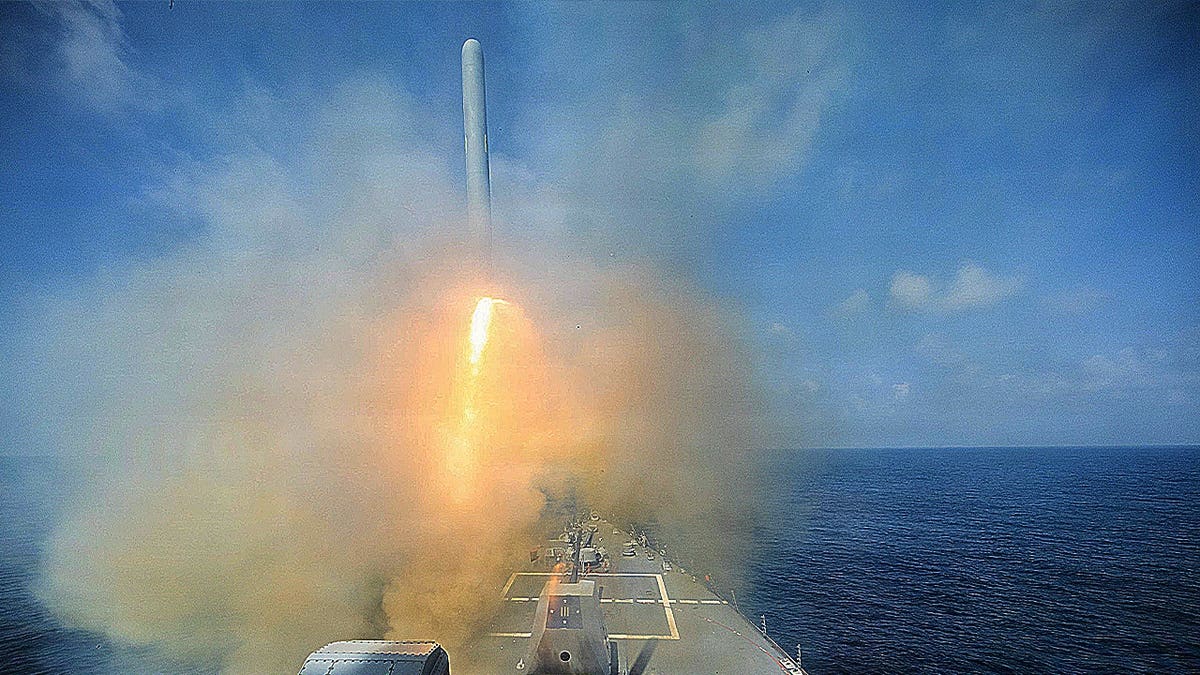
Arleigh Burke-class guided-missile destroyer USS Spruance fires a Tomahawk Land Attack Missile in support of Operation Epic Fury, at an undisclosed location, February 28, 2026. (U.S. Navy/Handout via Reuters)
Startups are hoping to bring down some of the costs to produce hypersonic weapons with more affordable missiles and increased testing capabilities.
“The weapon itself is under $500,000, which if you know about munitions, that’s incredibly cheap,” Castelion co-founder and CEO Bryon Hargis said.
The Army and Navy are investing in Castelion’s Blackbeard hypersonic weapon, which the company says it is designed for mass production.
“It is a story about hypersonics and what they can provide in terms of a weapon, but it’s really a story of American manufacturing,” Hargis said. “The company is focused on providing America options to have that middle deterrence layer and we’re doing that through production.”
This year Castelion began building what it says will be the largest dedicated hypersonic weapon production facility in the U.S. Project Ranger is expected to produce thousands of Blackbeard weapons annually. Those will eventually be used to fill Castelion’s various contracts, such as integrating the weapons into the U.S. Navy’s F/A-18 Super Hornet Jets, incorporating the system into the U.S. Army’s HIMARS and deploying Blackbeard on unmanned surface vessels.
“The advantage of a hypersonic system is that it goes very far, it gets there quickly, and it’s highly survivable because of that maneuverability. And that’s important for achieving deterrence because it’s hard to shoot down,” Hargis said.
Hypersonic weapons remain mostly in Earth’s atmosphere. The missiles are maneuverable during flight and can strike a target quickly, in 15-30 minutes from around 1,725 miles away.
US REBUILDING WEAPONS STOCKPILE COULD DELAY ORDERS FROM ALLIES
“If you don’t know what the target would be initially, unlike a ballistic missile where you can calculate where it’ll land, you might misinterpret, for example, an incoming strike as a decapitation attempt. And that would be very concerning,” Liang said.
Developers say the U.S. speaks with other countries about missile launches and what the intended targets are. But there are other concerns that hypersonic maneuverability could lead to inaccuracy.
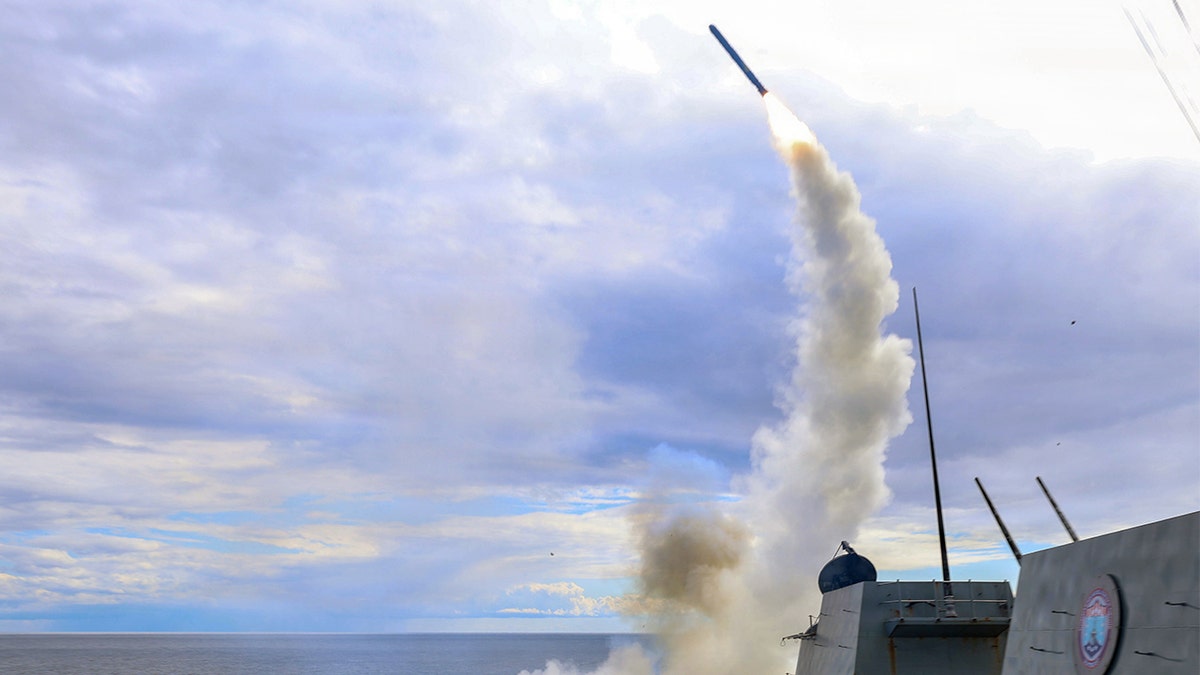
Guided-missile destroyer USS Thomas Hudner fires a Tomahawk land attack missile in support of Operation Epic Fury, on March 1, 2026. (U.S. Navy via Getty Images)
“Technologies do tend to improve over time as testing and especially as experience with use builds up, but there are pretty important physical constraints on the performance of these systems,” said Tracy.
Defense contractor Rocket Lab is working with the War Department to improve hypersonic missile capabilities through an increasing number of test launches.
INSIDE AMERICA’S LASER REVOLUTION AS THE MILITARY NEARS BIG BATTLEFIELD BREAKTHROUGH
“With our HASTE program, what we have enabled is low cost, high frequency hypersonic and missile defense testing. And when you can say that you can get that cheaper and faster, now you’re looking at more of a shots on goal approach to demonstrating capability of the technology insertion cycle,” Vice President of Global Launch Services at Rocket Lab Brian Rogers said.
Rocket Lab’s HASTE is a suborbital testbed launch vehicle that provides flight test opportunities for the government to advance hypersonic and suborbital system technology development. The vehicle is derived from Rocket Lab’s Electron rocket, which has launched nearly 100 missions.
“Rather than saying we need to be stuck in an analysis environment and then it’s a very rigorous test campaign that costs a lot of money and involves a lot people, now you can say we’re planning 12 tests this year. We don’t have to bet the farm on any one of them. Which allows us to take more risk and really move the needle in terms of technology development,” Rogers said.
The U.S. military has never used a hypersonic weapon but has explored deploying its Dark Eagle to the Middle East.
CLICK HERE TO DOWNLOAD THE FOX NEWS APP
“I would be very surprised if we used them and would be even more surprised if we used it extensively because of the small number of missiles that exist and the concerns already about the munitions stockpile,” Liang said.