

Inside the Pentagon’s laser revolution
Laser weapons are moving beyond the lab and into military operations. Center for Strategic and International Studies missile defense expert Tom Karako breaks down what’s changed, what lasers can actually do, and why they won’t replace missiles.
NEWYou can now listen to Fox News articles!
For decades, laser weapons have represented one of the Pentagon’s most ambitious technological goals — promising to shoot down enemy drones and missiles at the speed of light without expending costly interceptors.
Now, after years of testing and false starts, the Army appears poised to take its biggest step yet toward making that vision a battlefield reality.
The Army is nearing a contract award for the enduring high energy laser (E-HEL), a system that, if fielded as expected, would represent the service’s first laser weapon to transition into a permanent operational capability.
The development comes as the Pentagon races to adapt to a new era of warfare in which inexpensive drones can overwhelm traditional air defenses and force militaries to expend missile interceptors costing hundreds of thousands — or even millions — of dollars. If fielded, the enduring high energy laser would mark a significant step toward giving U.S. forces a new way to counter those threats without relying solely on costly kinetic weapons.
PENTAGON CONSOLIDATES DRONE OVERSIGHT AS TRUMP ADMINISTRATION PUSHES RAPID UNMANNED WARFARE EXPANSION
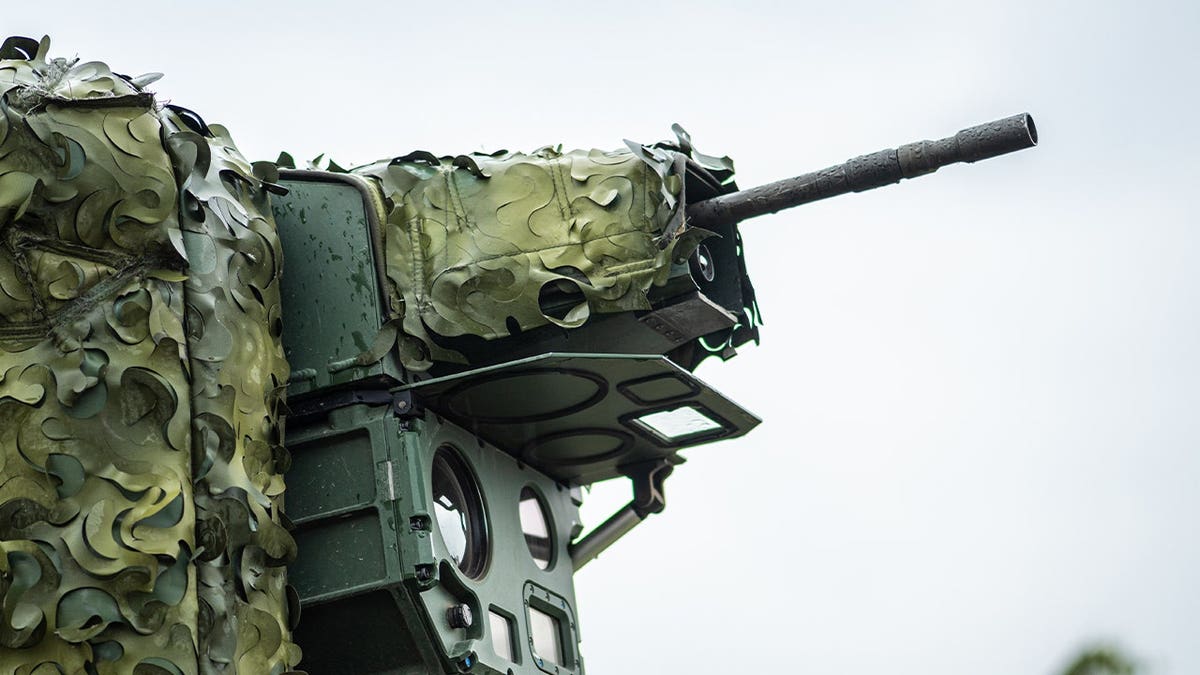
Anti-drone laser system trialed on a Stryker combat military vehicle with a machine gun aimed at the sky in Ukraine during a counteroffensive. (Michelle Ursi/Getty Images)
In July, Army acquisition chief Lt. Gen. Frank Lozano said the service was negotiating a contract with AeroVironment for the Enduring High Energy Laser, describing it as the Army’s first program of record for a family of high-energy laser systems. He said the technology had shown “a lot of recent promise and capability” during testing at White Sands Missile Range in New Mexico.
A source with knowledge of the program told Fox News Digital the Army is nearing a contract award, though negotiations are continuing and nothing has been finalized.
The Army’s move is not happening in isolation.
In July, the Air Force disclosed it is using the compact laser weapon system at multiple locations overseas to defend against drones. The Navy, meanwhile, has spent years testing its high energy laser with integrated optical-dazzler and surveillance (HELIOS) aboard destroyers, gradually integrating directed-energy weapons into fleet operations.
Together, the developments suggest the Pentagon may be entering a new phase for directed-energy weapons after decades of research and billions of dollars in investment.
The U.S. is not alone in pursuing the technology. Israel has begun deploying its Iron Beam laser air defense system — developed with significant U.S. support — to counter rockets, mortars and drones, while China has publicly showcased a growing range of military laser systems and counter-drone weapons as it expands its own directed-energy capabilities.
Even so, the War Department has spent decades pursuing laser weapons, with many early U.S. programs struggling with technical hurdles ranging from power generation and beam control to thermal management and reliability in operational environments.
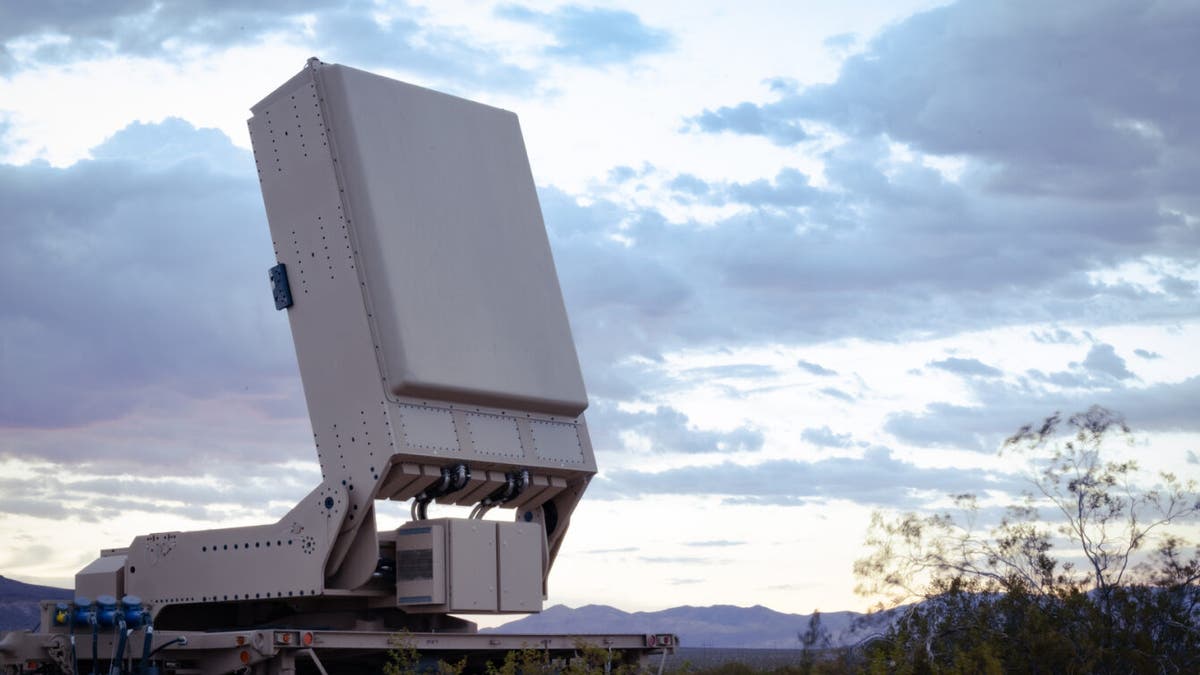
Epirus’ Leonidas counter-drone system sends out a high-powered microwave beam that stops drones in their tracks.
“It’s not about the laser anymore,” Tom Karako, director of the Missile Defense Project at the Center for Strategic and International Studies, told Fox News Digital. “It’s all these other things that make it workable as a weapon system” — from ensuring it can withstand dust, heat and bad weather to developing doctrine, training operators and maintaining the systems in the field.
And because laser beams can continue traveling well beyond their intended target, the military also must ensure they do not inadvertently illuminate satellites or other aircraft, one reason integrating the technology into everyday operations has proven more complicated than simply building a powerful laser.
The shift has been driven in large part by the rapid proliferation of inexpensive drones across battlefields in Ukraine, the Middle East and the Red Sea, forcing militaries to rethink how they defend against increasingly cheap aerial threats.
Even as lasers move closer to operational use, they are unlikely to replace traditional missile defenses.
Unlike missiles, which can travel over the horizon to engage distant threats, lasers are largely line-of-sight weapons, meaning they can only strike targets they can directly “see.”
US DRAINS CRITICAL MISSILE STOCKPILES IN IRAN WAR AS YEARSLONG REBUILD LOOMS
“It’s great for when that drone is coming in on top of you,” Karako said. “But it’s more difficult to be able to get past the horizon.”
That means lasers are expected to become another layer of the Pentagon’s air defense architecture rather than a replacement for kinetic interceptors. Missiles will still be needed to engage threats at long distances and in adverse conditions, while lasers are likely to be most effective against drones and other aerial threats that have already entered a defended area.
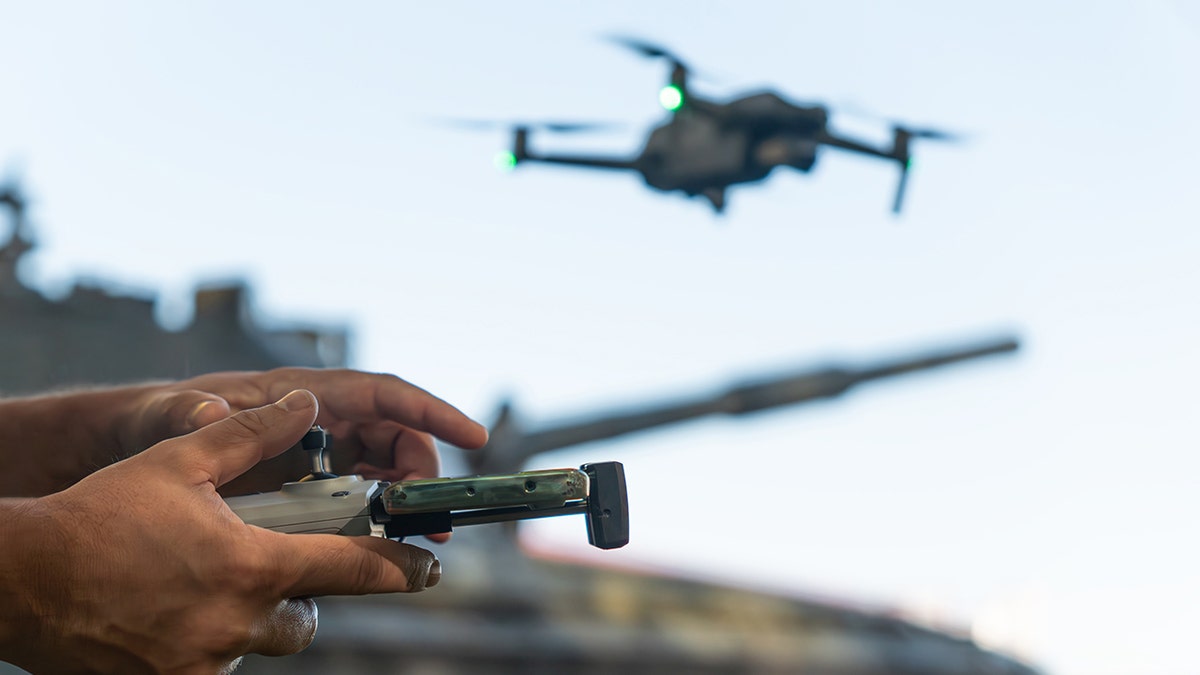
The unnamed company reportedly told attendees at the Army’s UAS and Launched Effects Summit that their aircraft was behind the mystery drones in New Jersey last year, according to The New York Post. (iStock)
The Army is also pursuing a next-generation counter-drone missile expected to cost less than $150,000 per interceptor, part of a broader effort to expand lower-cost options for defeating unmanned aircraft.
Lasers are only one piece of the Pentagon’s broader directed-energy push. The military also is testing high-powered microwave systems such as Epirus’ Leonidas, which are designed to defend against one of the battlefield’s fastest-growing threats: swarms of inexpensive drones.
Rather than relying on a kinetic interceptor, high-powered microwaves use bursts of electromagnetic energy to disrupt the electronics of multiple nearby unmanned aircraft simultaneously.
CLICK HERE TO DOWNLOAD THE FOX NEWS APP
The Pentagon also is investing in radio-frequency technologies capable of jamming communications between drones and their operators or interfering with satellite navigation signals, potentially causing unmanned aircraft to lose control.