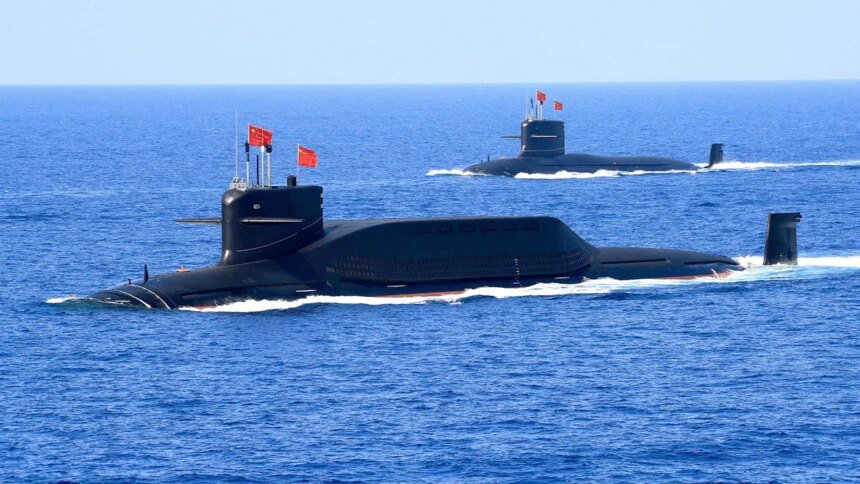
NEWYou can now listen to Fox News articles!
Sound alarms are blaring over an escalating partnership between Russia and China to subvert the U.S. Military amid rising hostility between the world powers.
Rear Adm. Mark Montgomery tells Fox News Digital that Moscow may be providing Beijing with technology to make its submarines harder for the U.S. Navy to detect, potentially eroding a key military advantage in the tensions over Taiwan.
“Russia is giving incredibly important technology to China. They’re allegedly giving them submarine quieting technology,” Montgomery, co-author of the new book “Axis of Aggressors,” told Fox News Digital.
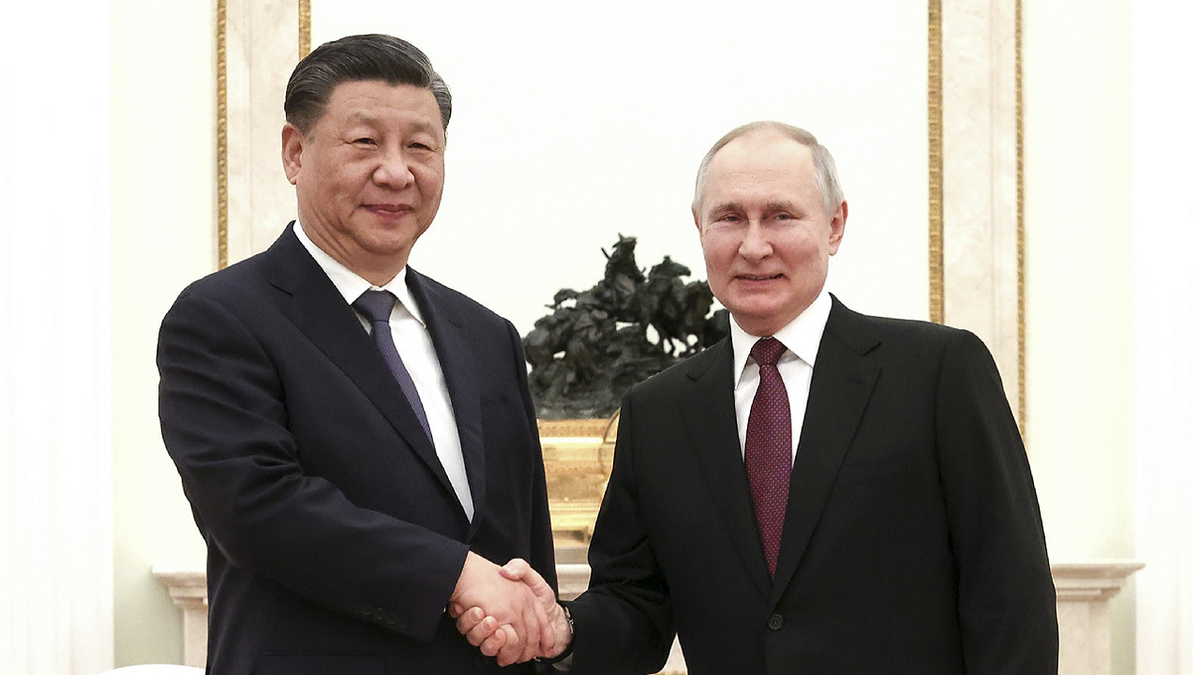
President Vladimir Putin and Chinese President Xi Jinping shake hands before a meeting at the Kremlin in Moscow, Russia, on Monday, March 20. (AP/Russian Presidential Press Office via AP)
THREE KEY REASONS WHY AMERICA CANNOT AFFORD TO LOSE TAIWAN TO COMMUNIST CHINA
Montgomery said Russian forces are providing the Chinese Communist Party (CCP) with submarine-quieting technology, an area where China has long sought to improve its capabilities. Such a transfer, he warned, could weaken a critical U.S. advantage in undersea warfare — a gap that has long favored American forces.
“Any weakening of our asymmetric advantage in undersea warfare is a big deal,” he cautioned.
The Navy says its submarine force relies on technological superiority and stealth to maintain its undersea advantage, while China has continued to face weaknesses in submarine propulsion and quieting even as it rapidly modernizes its fleet.
Quieting technology reduces a submarine’s acoustic signature, making it harder to detect and track. Russian assistance in that area could help Beijing narrow the gap, complicating the U.S. Navy’s ability to find Chinese submarines in a potential future conflict over Taiwan’s independence from the CCP.
The Chinese Embassy did not directly address whether Beijing has received Russian submarine-quieting technology when reached by Fox News Digital.
“Military cooperation between China and Russia consistently adheres to the principles of non-alliance, non-confrontation, and non-targeting of third parties, playing a significant role in safeguarding the sovereignty and security of both nations and maintaining international and regional peace and stability,” the embassy said in a statement. “We hope that relevant parties will view China-Russia military cooperation objectively and rationally, and stop groundless speculation.”
The embassy said Taiwan is China’s internal affair and urged the U.S. to safeguard stability in the bilateral relationship and across the Taiwan Strait.
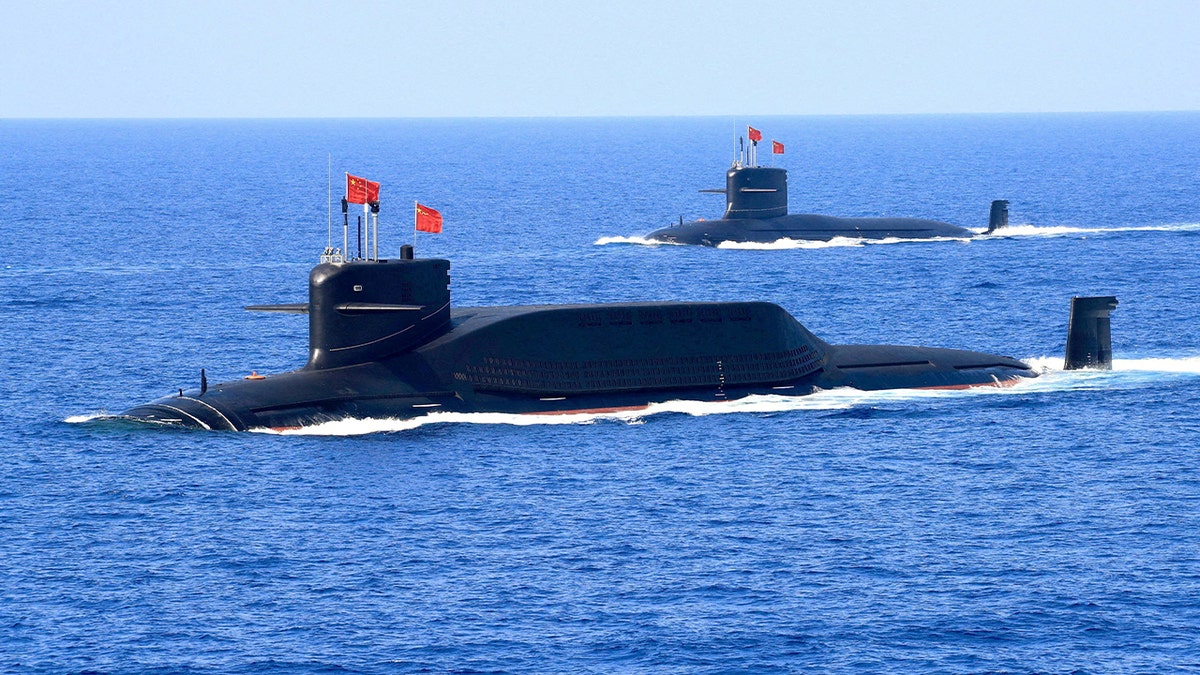
A nuclear-powered Type 094A Jin-class ballistic missile submarine of the Chinese People’s Liberation Army (PLA) Navy navigates during a military display in the South China Sea. (Stringer/Reuters)
Montgomery’s warning echoes concerns raised by Adm. Samuel Paparo, commander of U.S. Indo-Pacific Command, who told the Senate Armed Services Committee in April 2025 that China was receiving “potentially submarine quieting help” from Russia.
US FALLS BEHIND IN HYPERSONIC RACE AS CHINA, RUSSIA GAIN EDGE
Paparo said China’s backing of Russia’s war effort — including machine tools and legacy chips — was part of a broader exchange in which Moscow was returning assistance in military areas where it holds particular strengths.
The exchange reflects a deepening relationship in which Russia and China are increasingly providing capabilities the other lacks, Montgomery said.
“This transactional relationship is putting the United States and its most important allies and partners at risk,” he said.
Paparo sounded a similar warning in November 2024, saying he expected Russia to provide China submarine technology that could help close America’s undersea advantage. He described the relationship between Moscow and Beijing as a “transactional symbiosis.”
China, meanwhile, has helped Russia rebuild its defense industrial base during the war in Ukraine. Paparo told senators Beijing provided 70% of the machine tools and 90% of the legacy chips that enabled Moscow to rebuild its war machine.
Montgomery said China’s support extends beyond those supplies.
“And then China has backstopped the whole thing,” Montgomery said, pointing to increased Chinese foreign direct investment and trade with Russia as well as components used in Moscow’s ballistic, cruise and hypersonic missiles.
The support has helped keep Russia’s economy and war machine operating, Montgomery argued.
In return, he said, Moscow is increasingly providing Beijing with military technology it had previously been reluctant to share — including the alleged submarine-quieting assistance.
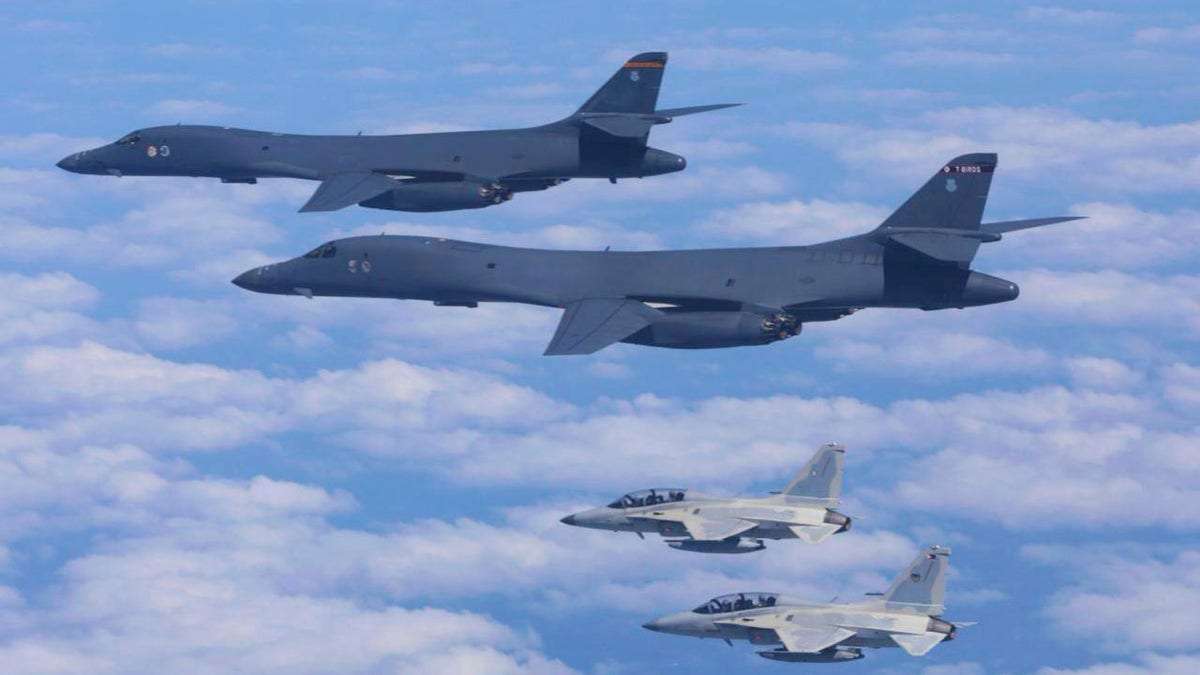
Two Philippine Air Force FA-50 fighter jets fly with two U.S. Air Force B-1 bomber aircraft during a joint patrol and training over the South China Sea on Tuesday, Feb.4, 2025. (Philippine Air Force via AP)
In October 2024, the Treasury Department said a Russian defense firm coordinated production of Garpiya attack drones at factories in China, using Chinese-made engines and components before the weapons were transferred to Russia for use in Ukraine.
Russia has provided Beijing with more direct military assistance as well. A 2025 RUSI investigation, based on leaked Russian contracts and correspondence, found that Moscow agreed to equip and train a Chinese airborne battalion and transfer technology that could help Beijing develop similar capabilities itself.
Russia’s full-scale invasion of Ukraine is now in its fifth year, with no ceasefire agreement in place despite continued diplomatic efforts. The prolonged war has deepened Moscow’s dependence on Chinese industrial and financial support while giving Russia battlefield experience and military technologies that could be valuable to Beijing in a future Taiwan contingency.
For the U.S., the stakes are particularly acute around Taiwan. American submarines are central to U.S. planning for a potential Indo-Pacific conflict, and quieter Chinese vessels could make it harder to track, deter and counter the People’s Liberation Army Navy in waters surrounding the island.
CLICK HERE TO DOWNLOAD THE FOX NEWS APP
Montgomery said the possible transfer reflects the broader argument of Axis of Aggressors : America’s adversaries are increasingly trading the capabilities each lacks, creating challenges that span Europe and the Indo-Pacific.
Fox News Digital has reached out to the Russian embassy for comment. U.S. Pacific Command declined to comment.