- Fake ShinyHunters sextortion email targets Carnival customers
- Carnival data breach gives the scam credibility
- Warning signs reveal the fake extortion email
- Clean security scans provide some reassurance
- Ways to stay safe from sextortion email scams
- 1) Do not pay or reply to the sender
- 2) Report and delete the sextortion email
- 3) Secure your Carnival and email accounts
- 4) Check sign-ins and hidden email forwarding
- 5) Watch for identity theft after the Carnival breach
- 6) Remove your personal information from the web
- 7) Use strong antivirus protection
- When a sextortion email requires more action
- Kurt’s key takeaways
NEWYou can now listen to Fox News articles!
Wayne P. of Evangeline, Louisiana, opened an email that would make almost anyone’s stomach drop. The sender claimed to represent the ShinyHunters hacking group and demanded $2,000 in Litecoin within 48 hours. The message also claimed hackers had recorded intimate videos through Wayne’s camera and planned to send them to his contacts.
Wayne paused instead of paying. He ran security scans on his phone and PC, then contacted CyberGuy.
“Just received the message below. I think it’s phony and security scans of my phone and PC indicate no issues. I also forwarded this to ‘reportphishing.’ Any comments?”
Wayne P., Evangeline, Louisiana
Wayne’s instincts were right. The email closely matches a widespread sextortion campaign that uses real breach information to support an invented device takeover. So, what gave this scam away, and what should you do if a threat like this lands in your inbox?
AMAZON RECALL TEXT SCAM COMES WITH RED FLAGS
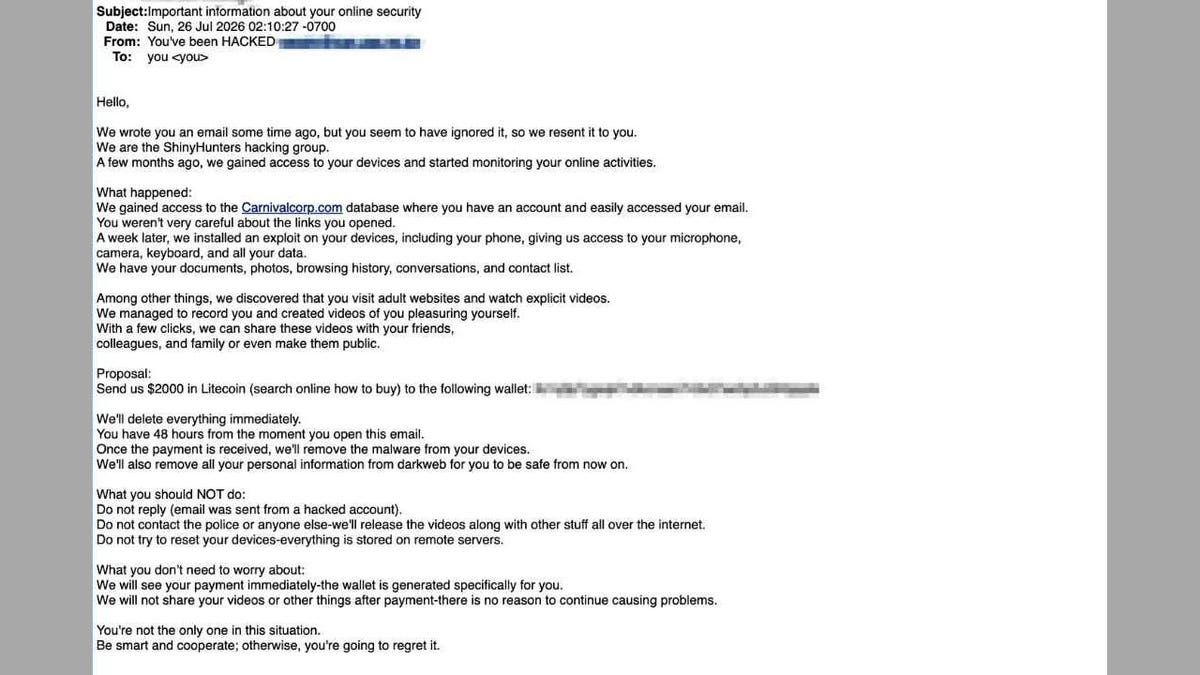
This is the actual sextortion email sent to Wayne, using Carnival breach details, a $2,000 Litecoin demand and a 48-hour deadline to create panic. (Kurt “CyberGuy” Knutsson)
CyberGuy Live: Missed “Sick of Spam?” Get the replay and checklist
Our free CyberGuy Live class, “Sick of Spam?”, has ended, but you can still watch the full replay and download our spam-stopping checklist. Kurt “CyberGuy” Knutsson walks you step by step through simple ways to reduce robocalls, spam texts, junk email and unwanted messages. You’ll also learn how to curb political texts, clean up your inbox and spot messages that could put your personal information at risk.
Get the free replay and checklist now at CyberGuyLive.com.
Fake ShinyHunters sextortion email targets Carnival customers
Wayne’s email follows a familiar sextortion script. The sender claims hackers reached his phone and computer, then says they recorded intimate activity through his camera. However, the message offers no proof. Wayne received no screenshot, stolen file or sample of the supposed recording. The demand for $2,000 in Litecoin, the 48-hour deadline and the warning against contacting police all point to an extortion scam built to create panic.
The FBI has warned that emails signed with the ShinyHunters name may contain false claims about embarrassing photos or videos. In many cases, the material described in the message never existed. CyberGuy has covered similar sextortion emails that use personal details and Google Maps images to make a bluff feel disturbingly personal.
Carnival data breach gives the scam credibility
The scam contains one accurate detail. Carnival Corporation disclosed a data breach after an April 2026 social engineering attack. Carnival said its security team found unauthorized activity involving an employee account on April 14. The company blocked the activity and brought in outside security experts. On April 22, investigators determined that the attacker had copied personal information. The exposed data varied by person. Carnival listed names, home addresses, email addresses, phone numbers, birth dates and government-issued identification numbers. The company began sending notices on May 27. It also offered eligible people in the U.S. two years of complimentary credit monitoring.
CyberGuy previously explained how the Carnival breach may put your travel data at risk. Our report noted that nearly 6 million people may face phishing or identity theft risks after the breach. A scammer may know that you used Carnival or Holland America because your information appeared in leaked data. However, an email address alone gives the sender no control over your phone, camera, microphone or keyboard. The breach supplies the believable detail. The scammer invents the rest.
CyberGuy reached out to Carnival for comment, and a Carnival Corporation spokesperson provided us with the following statement:
“In April, we identified unauthorized access to a limited part of our IT system caused by a social engineering attack on a single user account. We immediately blocked the activity, engaged third-party security experts and alerted law enforcement. Our investigation found certain personal information was illegally accessed. We’re notifying affected individuals and deeply regret any concern this causes. Protecting the privacy and security of personal data is a priority for us and we’ve added new layers of security and monitoring on top of the comprehensive protections already in place. We’ll also continue advancing our defenses against evolving threats.”
Warning signs reveal the fake extortion email
Wayne’s message contains several signs of a bluff. First, it came from an unrelated address. The sender offered no screenshot, stolen file or other evidence of access. Meanwhile, the message demanded cryptocurrency and imposed a 48-hour deadline. It warned Wayne against contacting police and told him not to reset his devices. Those instructions create panic while discouraging outside advice.
The sender also promised to remove Wayne’s information from the dark web after payment. The email provides no way to verify that claim. Paying could also confirm that the address reaches someone willing to respond. The FTC warns that blackmail emails may claim access to a computer or webcam. Some messages include information exposed in a data breach to make the story sound credible. The agency advises recipients to avoid payment.
COULD THE 7-ELEVEN BREACH AFFECT YOU?

Scammers may combine real breach data with invented webcam threats to pressure victims into sending cryptocurrency before seeking help. (Photo by Nikolas Kokovlis/NurPhoto via Getty Images)
Clean security scans provide some reassurance
Wayne’s clean scans support the conclusion that the email contains an empty threat. Still, no single scan can evaluate every online account tied to an email address. Based on the message alone, Wayne has no reason to erase or factory-reset his devices. The situation changes if he clicked a link, opened an attachment or installed software.
Therefore, the next step involves checking accounts rather than wiping devices. Review the recent sign-in history for your email account. Then inspect forwarding settings and inbox rules for anything unfamiliar. A criminal with email access may create a rule that secretly sends copies of your messages elsewhere.
Ways to stay safe from sextortion email scams
A fake threat still deserves a calm security check. These steps can help you close possible openings and prepare for follow-up scams.
1) Do not pay or reply to the sender
Do not send cryptocurrency. Avoid replying to the email as well. A response confirms that someone reads the address. It may encourage the scammer to increase the pressure or send another demand.
2) Report and delete the sextortion email
Wayne did the right thing by forwarding the message to reportphishing@apwg.org. The Anti-Phishing Working Group accepts suspicious emails for analysis and archiving. When your email service allows it, forward the original message as an attachment. That method preserves more technical information. You can also report the message through the FTC’s ReportFraud website at reportfraud.ftc.gov/ and the FBI’s Internet Crime Complaint Center at ic3.gov/. IC3 accepts reports involving cyber-enabled fraud, online scams and other internet crimes. After reporting it, mark the email as phishing or spam. Then delete it.
3) Secure your Carnival and email accounts
Carnival’s public notice omits account passwords from its list of exposed information. Even so, change your Carnival or Holland America password if you reused it somewhere else. Your email account deserves extra attention because password reset messages often land there. Use a long, unique password and turn on two-factor authentication. A trusted password manager can create and store unique passwords. That prevents one exposed password from unlocking several accounts.
4) Check sign-ins and hidden email forwarding
Open your email provider’s security page and review recent logins. Look for devices or locations that you do not recognize. Check the dates and times as well. Next, check automatic forwarding and inbox rules. Remove anything unfamiliar. Then change the password and sign out of other sessions.
WHAT A SCAMMER SEES THE MOMENT THEY GOOGLE YOUR NAME

Carnival said attackers copied some customers’ personal information after gaining unauthorized access to an employee account in April 2026. (Patrick Connolly/Orlando Sentinel/Tribune News Service/Getty Images)
5) Watch for identity theft after the Carnival breach
Carnival said some exposed records contained government identification numbers. Anyone who received a breach notice should read it carefully and use the offered credit monitoring when eligible. Review bank and credit card statements for unfamiliar activity. You should also check your credit reports. For stronger protection, consider a credit freeze with all three major bureaus. CyberGuy’s online security checklist at cyberguy.com explains more steps you can take after your information appears in a breach.
6) Remove your personal information from the web
Scammers often combine breach data with details from people-search sites and data brokers. That research can uncover your address, phone number, age, relatives or previous locations. Removing those records cannot stop every scam. However, it can reduce the information criminals use to personalize future messages. A data removal service can submit requests to data brokers on your behalf and continue checking for information that reappears. Check out my top picks for data removal services and get a free scan to find out if your personal information is already out on the web by visiting Cyberguy.com
7) Use strong antivirus protection
Wayne’s email contained no link or attachment in the copy he shared. Future scam messages may include both. Strong antivirus protection can warn you about malicious websites and phishing pages. It may also flag unsafe downloads or scan supported devices for malware. Even with security software, avoid links and attachments in alarming messages. Instead, type the company’s official web address into your browser. Get my picks for the best 2026 antivirus protection winners for your Windows, Mac, Android & iOS devices at Cyberguy.com
When a sextortion email requires more action
Take stronger action when you interact with the message.
- Change exposed passwords immediately if you entered them on a linked page. Use a trusted device for the change. Then contact the affected company through its official website.
- Run updated security scans if you opened an attachment or installed software. Also remove unfamiliar apps and review browser extensions.
- If you sent cryptocurrency, contact the exchange or payment provider right away. A crypto transfer can be difficult to reverse. However, the provider may document the fraud or flag the receiving wallet.
Wayne reported no clicks or downloads. His scans also found no problems. Based on those facts, the message appears to rely on leaked information and fear rather than device access.
Kurt’s key takeaways
Wayne handled the threat correctly. He avoided payment, checked his devices and reported the email before fear could take over. The Carnival breach may explain how the sender connected Wayne to the cruise company. Still, the message offered no proof that anyone accessed his camera, microphone or computer. Scammers often use one accurate detail to make a much larger lie feel believable. Secure the accounts tied to the exposed email address and review recent sign-ins for anything unfamiliar. Most importantly, slow down before reacting to an urgent demand. Once you look for real evidence, threats like this often begin to fall apart.
Have you received a threatening email that used real details about you? Write to us and tell us what it claimed in the comments below so we can help other readers spot the warning signs. Let us know by writing to us at Cyberguy.com
CLICK HERE TO DOWNLOAD THE FOX NEWS APP
Sign up for my FREE CyberGuy Report
- Get my best tech tips, urgent security alerts and exclusive deals delivered straight to your inbox.
- For simple, real-world ways to spot scams early and stay protected, visit CyberGuy.com – trusted by millions who watch CyberGuy on TV daily.
- Plus, you’ll get instant access to my Ultimate Scam Survival Guide free when you join.
Copyright 2026 CyberGuy.com. All rights reserved.